It’s a long journey ‘up river’ toward what
many US
troopers say is the ‘Real War’, the one against the Taliban in Afghanistan. Iraq they say is a holding
operation, a ‘money machine’; the final victory of the ‘military industrial
complex’ over the taxpayers of the US.
The journey to Afghanistan begins at Ali Al Salam,
the huge US Airfield in Kuwait
that’s the leaping off point for Iraq air support. Transport is space
available for a seat on a C-17 transport to Bagram Airfield, located forty some
miles north of the capital city Kabul. The
US air base in Okinawa was staging area for Viet Nam in the mid sixties; with
Pan Am and Braniff often continuing the trip to Tan Son Nhut Airfield, Saigon;
the capital of the Republic of Viet Nam ( RVN).
 |
| Leaving Jalalabad airfield for the high peaks. |
Forces stationed at Bagram live among tree line streets and
sidewalks that have been in place since the Russian invasion in 1979. It’s quiet, humane; and much more relaxed than
the crowded, very orderly bases in Iraq.
Military transport travelers are housed in makeshift housing for the few
days that it will take to catch a flight farther inland.
Camp
Alpha in Saigon filled the same purpose though it was anything but
orderly, or peaceful. Helicopters were
coming and going all hours of the day and night. The routine thump of mortars
and artillery, along with the earth shaking vibrations of ‘Rolling Thunder’ off
west near the Cambodian border slowly soaked into the consciousness. Then finally a realization that just beyond
the front gates were the sights, sounds and vices of the Saigon streets.
“I’ll have you out of here tomorrow morning one way or the
other’ said Sgt. Adam Phelps of the public affairs office here at Bagram. “If the C-130s are full there’ll be chopper
flying the circuit which stops at Jalalabad”.
 |
| Mounting up at Camp Blessing. |
The army Blackhawk lifts from Bagram airfield and climbs
over the high peaks to the east in the direction of
Pakistan. Jalalabad, the fourth largest city in
Afghanistan
lies midway. Rugged, inhospitable peaks
of unspeakable beauty continue to fill the windscreen. The door gunner suddenly
begins firing as the helicopter skims very low to a ridge. They’re a warning to those on the ground that
might think of firing off a few rounds in the choppers direction. Small villages, timeless in their simplicity;
disappear from view as the chopper drops behind ridge after ridge, before
lowering finally to the flat plane of Jalalabad.
As the chopper lands at the airfield in Jalalabad we’re
hustled over to Camp Fenty on the outskirts of said field to the headquarters
of the 173rd Airborne Brigade, the functioning army unit in this sector, RC
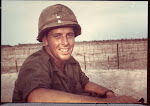
East. The 173rd was based on the Bien Hoa Air Base in
Viet Nam when I was there in 1966-67. They supported my unit at various times while on patrol in the country side
east of Long Binh while wording off VC saboteurs attacking the large Ammo dump
located there. That was exactly 40 years ago….and I’m back in the field.
 |
| Able Main. |
Les Neuhaus of the Stars and Stripes along with myself end
up waiting a couple of days for a ride to Camp Blessing, another jumping off
point to the High Peaks and Operation Rock Avalanche the last major operation
planned for this year. As we travel ‘up
river’ the setting is rougher and rougher. More like the old country….without the
green. I’d have to say that Afghanistan
is more spectacular but nothing can measure up to the beauty of the greens in
Viet Nam.
Camp Fenty is rougher than Bagram, but civilized…there’s a
Green Beans Coffee shack up behind the mess hall. There was also a new building, a hangar it
looks like along the airstrip that’s surrounded by razor wire and camera surveillance. The word is it’s CIA and looking ahead this
is the strip where Seal Team Six departed from on it’s way to the killing of
Osama Bin Ladin years later.
 |
| Fireing off mortars at Able Main. |
Morning finds us in the air towards Camp Blessing. the next
stop on the journey to the Pech River Valley. Other reporters have shown up in
this desolate corner of Afghanistan. *Elizabeth
Rubin of the NY Times and *Tim Hetherington for Vanity Fare, as well as Les and
myself will be covering the troops. The
173
rd Airborne Brigade is preparing for its largest operation in
Afghanistan
thus far in its 15 month tour of duty.
Winter is coming to the high peaks of Afghanistan and this
will be the last major effort by the US Military until spring of ‘08 in its
battle against the insurgents. This high mountain country within 25 miles of
the Pakistan border is a known trail for foreigners supporting the Taliban in
their attempt to topple the existing Afghan national government.
“There are three valleys here that converge with the Pech River
Valley” said Capt. Jeff
Pickler of the 2nd Battalion, 198 Artillery as he began his
briefing. “Three companies will be air
assaulted in to the high peaks, then sweep down through all three valleys to
the Pech River.
Our plan is to clear all three of enemy elements at least till next spring.”
Great progress has been made with the local residents of the
Pech Valley since the 173rd began
their 15month tour in Afghanistan,
according to Capt. Pickler. The Pech River Road, a
modern highway being constructed through the valley has been contracted out to
local contractors by the 173rd, providing much needed salaries for
the local men. ,
“They’ve been so poor here that it was common for the
Taliban insurgents to pay the men to shoot at us from the hills,” said Capt.
Jeb Richards, also in attendance. “They
are making much better money working for us and the end product greatly
improves their quality of life. They
can’t lose and they know it”
 |
| Briefing for convoying from Able Main. |
155mm artillery is being sporadically fired as this briefing
is being held and I immediately think of the 'H & I Fire’ (harassment and interdiction)
that fired off, mostly at random targets, every night in Viet Nam. The noise is deafening and holds things up at
brief intervals. Shells are being called in
at locations near the very companies that are to be carrying out the air
assaults in the mountains over the next few days. According to Capt. Pickler, F-115s from
Bagram Field, and B-1s from Kuwait; as well as local artillery and Apache
gunships will be available for air support throughout this operation.
As the convoy approaches Able
Main a sigh of relief is breathed by all aboard. It’s been an uneventful journey. This Fire Base is a stripped down, no frills
operation. Tubes for urinals, cut off
oil drums under the out house four holers, a mess trailer for meals and sand
bagged bunkers for housing. There are
no ‘Kellogg, Brown & Roots’ visible on this compound. Excise the mess trailer and the laptops and
it’s ‘back in the Nam”.
 |
| Children who had mothers killed or wounded at Yaka China. |
As evening began to descend on
this remote station, the loud ‘blast’ of a mortar roared over the
compound. Momentarily, a flash of light
appeared on the ridge just north. A loud
boom echoed down through the valley. A
173rd mortar team was seeking out targets in the hills with the aid of a
forward observer. Eventually they had
the tube nearly perpendicular to the ground with the mortars landing on the
first low hill across the
Pech
River.
According to Capt. Louis Frketic,
commanding officer of Able Company which occupies Able Main, they have tracked
44 sub commanders of insurgent elements in the mountains nearby. Each commander has from 12 to 15 men under
his command. Estimates are that
there could be as many as 3 to 5,000
total potential combatants in this province.
Some of the most difficult fighters are Punjabi’s who have crossed the
border from Pakistan.
Later this same evening the
Company forms a convoy for the trip overland to Camp Wright near Asadabad where
two, Viet Nam era, Chinook, helicopters will lift sixty five 173rd
Airborne troopers from the LZ at Camp Wright in Asad Abad, Afghanistan for a
midnight landing in the high peaks of the Tribal Area, a few miles from the
Pakistan border. The men are edgy. Intel indicates the possibility of a hot LZ (landing
zone) on landing. It doesn’t help that Rock Avalanche has been held down for
twenty four hours due to civilian casualties on the Operations opening day.
 |
| Myself and Sgt. Loetz on Able Main. |
Apparently five people were killed and ten were wounded during
the assault on the night of Oct. 19 and extra time was needed to sort things
out with the families. Upon further investigation it turned out that the wounded,
along with some of their relatives were here at the native medical clinic at
Camp Wright and after speaking with Mohammud Ishag, a friend of one of the
wounded women’s family through an interpreter, a vastly different story
surfaced. These people are all from the small village of Yakha China in the
Pech district and were mistakenly fired upon by an American helicopter. In the
opinion of Mr. Ishag, there were no Al Qaeda, Taliban or other insurgents in
this area so it appears to have been another unfortunate incident that will win no ‘hearts and minds’ in this
country, nor in Iraq and for that matter; no more than it did in Viet Nam so
many years ago.
It’s near midnight before the choppers show up for the flight
to the high peaks. The Chinooks climbed
to 8,000 ft. before leveling off and settling in for a precarious landing along
the ridge line. No ground fire was
detected as the men hastily emptied the choppers dragging the skids of ammo
with them. The gun teams were the first
to take up positions overlooking the valleys on either side. As the perimeter was secured, troops not
posted for the night watch found secure spots to hunker down for a few hours
sleep. The temperature at this elevation
had dropped down to the high 30s F; much colder than most were accustomed to.
 |
| Morning lookout Rock Avalanche. |
“Scouts came in with us on the Chinooks”, said CPT Frketic
at the early morning briefing, “and I’ve got them deployed all sides and on the
outskirts a couple of small villages between here and the Pech River. They will report in via radio since they
won’t be returning to the command post here.
We can’t risk the ACMs (anti collation militias) following them back.”
By mid-day the command center had returned to a normal state
of readiness. CPT Frkitec was constantly
on the phone taking reports from the scouts and other units of the 503 Infantry
working the Rock Avalanche operation.
The troops who had manned the night positions were taking a well
deserved sleep in the warm sunshine.
 |
| Above the Pech Valley for Operation Rock Avalanche. |
“I’ve got some ‘bad guys’ calling among their units for help
from the next valley over” said Dave, the interpreter. “They need help with their wounded and
they’re saying that six of their own are dead.
It must be all that artillery fire we heard being fired off this
afternoon hit something. I think B
Company is at that location also, down near Yakha
China village, where the civilians
got hit a couple of days ago.”
As the sun was fading beyond the high peaks, CPT Frkitec
held another briefing. Since the
location of his Company had not been detected, he had decided to hold this
location till late afternoon the next day, before beginning the trek down
through the mountains to his home base at Able Main.
Late that night word came in from ISAF (International
Security Assistance Force), the NATO high command in Afghanistan, that there
was one KIA and two WIAs from *B Company, that had been operating near Yaka China. A request was made for the number of civilian
losses.
 |
| Les Neuhaus of the Stars and Stripes |
“It is not official policy to count civilian casualties”
said SFC Eric Hendrix, a public affairs NCO on the phone from Jalalabad. Unfortunately it's this attitude that lost the war in Viet Nam and is going to lose the one here. For some reason American's can't understand that if you bomb a guys house, kill his wife and kids, maybe poison his fields; he isn't going to be on your side.
The results of Operation Rock Avalanche will not be known
for three more days; or however long it takes for these hardened American
soldiers to fight their way down from the mountains to their home bases in the
Pech River Valley, Afghanistan.
*Once again though, echoes of Viet Nam…..remember Hamburger Hill. After a hard fought battle with many causalities and ultimate victory it reverted back to the VC three days later. When the
Americans leave these peaks and passes this territory will revert to the people
who live and fight here…as it did in 1988 when the Soviet Army pulled out and
in fact as it always has since the time of Alexander the Great.
--------------------------------------------------------------
*Tim Hetherington was
awarded the News Photo of the Year for a picture he took on this
operation. His video footage from Rock
Avalanche was used in the Oscar winning documentary ‘Restrepo’. He was killed a few years later on the job in
Benghazi, Libya.
*Sgt. Salvatore Giunta
of B Company became the first living soldier to receive the Medal of Honor
since the Viet Nam war for his brave actions during Rock Avalanche, one of the
defining events of the Afghan War.
*Elizabeth Rubin’s
piece in the New York Times magazine of February 24, 2008 has been called by
more than one reviewer the best piece of war reporting since Viet Nam.
*After years of
fighting for control of the Pech River Valley in Kunar Province, and the deaths
of well over one hundred soldiers, the US pulled it’s forces from that area for
good in February 2011. See the **February
25, 2011 New York Times.
**"What we figured out is that people in the Pech really aren't anti US or anti anything; they just want to be left alone," said one American military official familiar with the decision. "Our presence is what is destabilizing this area".