Showing posts with label Kandahar. Show all posts

Monday, October 25, 2010

Flying with the Afghan Air Force

KANDAHAR, AFGHANISTAN: US Air Force Col. Bernard Mater commanding officer of the 438th Expeditionary Group here in Kandahar Air Field (KAF) in Southern Afghanistan is conducting a preflight for this morning’s operation. Two MI 17 Russian helicopters are readied for a mission to re-supply an Afghan National Army (ANA) outpost one hundred and fifty miles north of Kandahar. The 438th is attached to the Afghanistan Air Force (AFF) to train air crew and other personnel required to operate and maintain these aircraft. Col. Mater ends his preflight and the men head for the ramp to prepare for the flight.


l to r Door gunner Sgt. Erica Thompson mans the Russian PKM machine gun as Col. Bernard Mater looks on.


“It’s been a great help that I’ve been able to establish a good relation ship with my opposite, General Yousuf’” says Col. Mater as he dons his flack vest, “and actually this whole detachment gets on extremely well with their opposites in the AFF.” The crew all wear flack vests and most are heavily armed. Taliban in this area have only small arms but one bullet can drop an aircraft if it hits in a vulnerable spot. These extremely sturdy Russian built machines are the aircraft of choice through out the third world. The UN has a fleet of at least a dozen on the other side of KAF.


“Their main advantage here in Afghanistan” said Col. Mater “beyond being a great platform is that they are so basic and don’t require high tech technicians to keep them in the air. The larger problem with the Afghans is that they need a fairly good command of English to read the manuals and that is provided north of Kabul at Bagram. They’ve got a good program there.”


Afghanistan countryside between FOB Land and Arghandab.


“MI-17, 576 taxi Runway 23, cleared for departure.” KAF air traffic control broadcasts on the radio. The helicopter has been prepared for flight and taxis to the announced runway. This morning the pilot is Maj. Micah West who normally flies a Huey. He’s completed a training program to qualify in the MI 17. His co pilot is Paeyinda-Mohammad. The crew is rounded out with Faroq the flight engineer, Kazeem in the crew chiefs station, and Tech Sgt. Erica Thompson the required medic. Sgt. Thompson also doubles as the door gunner manning the Russian built PKM 7.62 machine gun.


Afghanistan National Army soldiers departing MI 17 Helicopter for home base.


Maj. West climbs his aircrft rapidly to clear the KAF traffic pattern but drops the MI 17 down to a hundred feet or less as he parallels the one highway between Kandahar and Kabul. He will fly behind a ridge to stay out of line of sight to avoid any gun fire from the main highway. A second MI 17 follows along the same route. Two ship flights are standard operating procedure for all US aircraft in Afghanistan.
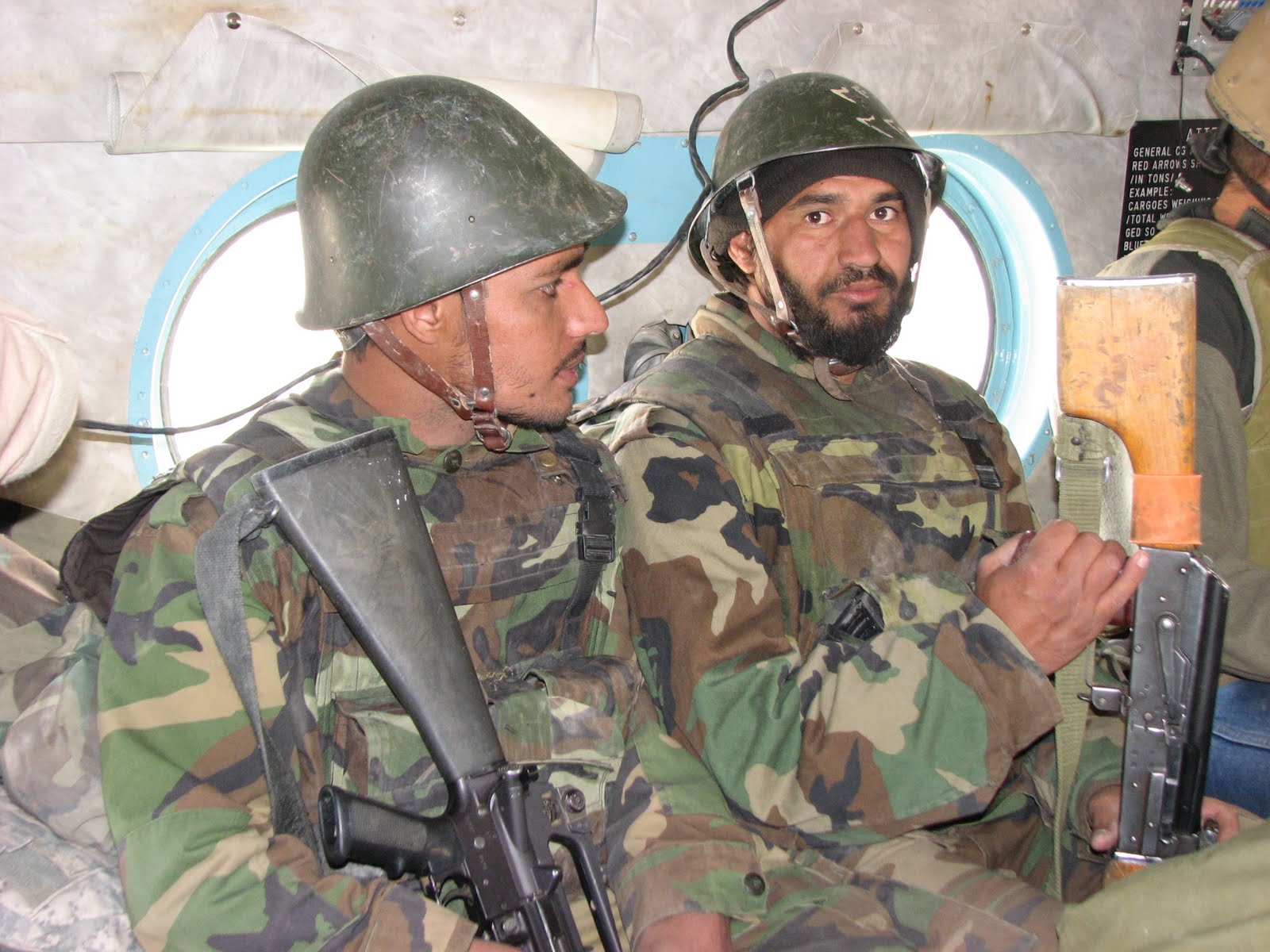


Two ANA soldiers being air transported to their home base.


Just prior to arriving over the town of Qalat the flight crosses over the paved road and heads more northwesterly towards Forward Operating Base (FOB) Lane. Gradually the land rises and the choppers fly along side ridges that soar above them. Mud houses, goats and camels occasionally appear in the barren, and sparsely populated countryside. Rivers are nearly dry this time of year so little vegetation is evident. Suddenly two Blackhawk gun ships cut in from the west and begin clearing s-turns leading the flight for the rest of the trip to FOB Lane.


This desolate FOB has been recently built by the US Army Corps of Engineers and is an excellent facility. After the two machines have shut down the clamshell doors at the rear of the aircraft are opened and they are loaded with hundred pound bags of potatoes, rice and onions.


“They certainly manage on a lot more basic diet than we do.” said Col. Mater. US mess halls in Afghanistan are famous for the quality and variety of foods that they serve for all US personnel and civilian employees. The Afghan forces have their own mess, and serve a traditional menu. ANA soldiers fill the remaining seats and the flight resumes to the town of Arghandab, not to be confused with the District of the same name, that was the site of recent battles between the Taliban and joint US and ANA forces on the outskirts of Kandahar City.


MI 17 helicopter airborne over Afghanistan on re-supply mission.


After off loading the supplies and soldiers both aircraft climb out of the dusty landing pad and follow the route of the circling Blackhawk gun ships back toward National Route #1. The MI 17s once again hug the ground at their normal cruise speed of 100 Knots and return to KAF without drawing ground fire. These crews fly this type of mission most days that have clear weather for their helicopters are not equipped for instrument flight.


*A version of this article was published by the Press Republican on November 17, 2010.

Tuesday, October 19, 2010

Kandahar-2010

KANDAHAR, AFGHANISTAN: Midway during the war in Viet Nam war, Tan Son Nhut airport on the outskirts of Saigon was the busiest in the world. Aircraft of every description covered the ramp along with most of the field that wasn’t runway. With the recent addition of 30,000 US troops to Afghanistan, along with their civilian support personnel, KAF (Kandahar Air Field) may be fast approaching that title. To date it is the busiest, single runway airport in the world.

“They’re even sprucing up the old civilian terminal for the upcoming Hajj, the annual Moslem pilgrimage to Mecca and Medina” said US Air Force Captain Joe Bauer. Capt. Bauer is a finance officer whose responsibility is training his counterpart in the developing Afghan Air Force (AFF). This morning he is guiding journalists who are waiting for transport to their embed locations on a tour of the facility. Capt. Bauer is assigned to the 38th Air Expeditionary Advisory Force which has the responsibility of training the Afghan Air Force.


Kandahar Air Field with Russian MI 17 helicopter in the foreground and a Russian freight plane taxing in the background.


New buildings are sprouting up along the flight line as well as nearly every vacant lot on this sprawling base. A recently completed steel hangar houses the fleet of six Russian built MI-17 helicopters, one of which is being torn apart for a hundred hour inspection. Another is on the ramp for training purposes while the remainder out on re-supply missions in the countryside. These tough all purpose machines are likened to an old Ford truck; very tough, and simple to operate and repair.

This area of KAF is to be the new headquarters of the Afghan Air Force. “We have $60 million worth of construction underway and intend to spend $180 million overall,” said Capt. Bauer. “This Afghan force is being built from scratch”, continued Captain Bauer. “Their Deputy Base Commander happens to have great credentials. He was a Mig 21 pilot and had trained as a cosmonaut years ago with the Russians, but he stands alone.”

As well as being an airport and military air base Kandahar Air Field is also the home of various US Army units as well as a mix of forces from other NATO countries. Canadian and Dutch forces have a great presence here however both are expected to be leaving in the near future. Presently the civilian and military population is in the neighborhood of 25,000. The geographic area has at least doubled in the last two years. If and when the US leaves this will be an enormous physical complex for the Afghans to manage.


Afghan pilot recruits at the main hangar on Kandahar Air Field.


Nearly two dozen print and video journalists have been waiting at the RC South Media Support Center for transport to their embed sites and are not interested in touring the base. Many live in Kabul full time. Nearly all of these reporters are to be assigned to Task Force Raider, a joint Afghan Army – NATO force operation in Helmand province about which not much is known. The word among journalists permanently based in Afghanistan is that news media are not wanted there yet because things may not be going as well as current official reports indicate.

Their feeling is that military authorities would prefer that media remain in the rear for the time being. Operation Dragon Strike which is being fought primarily in the Arghandab river valley in Kandahar province by US Army forces, US Special Forces and Military Police as well the Afghanistan Army soldiers. Various reporters covered the Battle for Marjah last February. Their published reports did not jive with the story put out by military publicists hence the military’s hesitancy inviting them in this early in an operation that has its own problems.

*A version of this article was published by the Press Republican on November 16, 2010.